

Travel Stories
Precision and Poetry: A Journey Through Japan with My Grandson
Precision and Poetry: A Journey Through Japan with My Grandson
The New Lens of Travel
This time, my travelling companion is my eighteen-year-old grandson, Jonah — bright, curious, and deeply fluent in the language of technology. It changes everything, travelling with youth. Before I’ve even packed my adapter, he’s fitted my phone with an eSIM — “Thirty dollars for a month of unlimited data,” he explains, his tone part patient, part amused, “instead of your ten dollars a day with Telstra.” Within minutes, my digital world hums to life, and I realize how very lucky I am to have him by my side.
Our journey to Tokyo begins in comfort. All Nippon Airways’ Premium Economy includes Air New Zealand lounge access, a thoughtful touch that hints at what’s to come. Even before we land, I’m reminded of Japan’s distinctive genius — everything works, and it works beautifully. Passport control is effortless, the machines quick and kind, and everyone — absolutely everyone — is unfailingly polite. The calm efficiency feels like a balm.
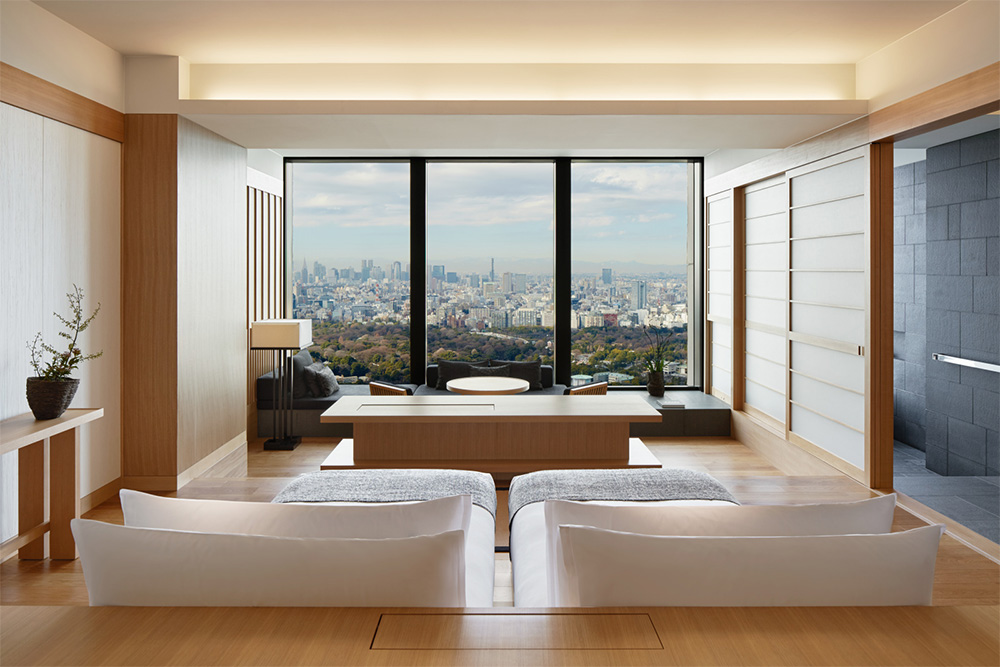
We check into our two-bedroom suite at dawn, and to my delight, it’s both elegantly appointed and astonishingly practical — a refrigerator, microwave, washer/dryer, every detail thought through. From the window, Tokyo hums in soft grey morning light. A two-minute walk away, a train station pulses with life. Jonah, naturally, is already mapping our route. In Japan, I quickly learn, the train isn’t merely transport — it’s the nation’s heartbeat.
Tokyo: Where Precision Meets Soul
Our first morning sets the tone. I’ve arranged an Art and Architecture tour with an extraordinary guide named Rafa, originally from Barcelona, who arrived in Japan over two decades ago to study under the great Tadao Ando — and never left. We meet him at Shibuya, that legendary crossroad of humanity, at an outdoor café where he sketches the history of Japan in swift black brushstrokes on a notepad, his voice quiet but compelling.
We begin at the Kenzo Tange Yoyogi National Stadium, built for the 1964 Olympics — a masterwork of post-war optimism. Its sweeping rooflines blend the essence of Shinto temples with modernist courage. “There’s no Nobel Prize for architecture,” Rafa tells us, “so the Pritzker family of Chicago created one.” Japan, he adds with quiet pride, has won more Pritzkers than almost any other country — and, in recent decades, several have been women. It’s the kind of detail that reveals so much about Japan: reverence for mastery, humility before beauty, and a quiet evolution always in progress.
From Yoyogi, we walk toward Omotesandō, Tokyo’s high temple of design — sleek, leafy, quietly extravagant. Down an unassuming staircase, Rafa leads us to a homewares gallery that feels like a dream. Long tables made from reclaimed timber gleam with colored lacquer — one plank painted canary yellow, another sea blue — the imperfections of the wood transformed into art. I find myself whispering, I want to take it all home. Japanese design, I realize, achieves what few others can: harmony between form and soul.
The Sensory Art of Everyday Life
The next day brings an immersion of another kind — TeamLab Planets, an experiential art installation where light, sound, and water dissolve the boundaries of perception. We walk barefoot through mirrored rooms and shallow pools, the reflections shifting with our every movement. It’s impossible to describe — part digital cathedral, part dreamscape — a reminder that art need not be confined to walls.
Later, in Ginza, we discover a five-storey temple of stationery. Japan, I decide, must be the most inventive country on earth. I try a staple-less stapler — yes, it exists — and it works perfectly. There’s a quiet joy in these discoveries, each object a tiny act of genius.
And, of course, we cannot resist Dover Street Market, Rei Kawakubo’s avant-garde playground. Here fashion becomes performance — textures, silhouettes, and ideas colliding in ways only Japan could make coherent.
That evening, I realize I’ve forgotten to recount our first day — and what a day it was.
Asakusa, once the capital, is now a charming echo of old Tokyo. The Senso-ji Temple, ornate and imposing, draws crowds beneath crimson lanterns and incense smoke. The rain begins as we wander, so we duck into the subway — destination Ginza again — and there, by chance, stumble upon a Muji flagship store unlike anything we’ve seen.
At street level, it’s a bakery and grocery; upstairs, an entire universe of design — stationery, homewares, perfect wooden cutting boards, even fruit the size of myths. Jonah, of course, knows the brand by heart. I, predictably, fall in love with everything. “Do you really need it?” a small voice in my head whispers. “Oh, how boring to be sensible,” I sigh, and Jonah laughs.
Tokyo on the Table
Every great journey eventually becomes a story told through food. Across from our hotel, a humble diner becomes our morning ritual. It began as a bakery, and still, the bread rivals Paris. Their French toast — thick, caramelized, golden — might be the best I’ve tasted. Even the maple syrup, served in a thimble-sized jug, feels like a work of art. My homemade granola and milk — simple, sublime — remind me that Japan elevates the ordinary to the exquisite.
Rafa recommends two small restaurants “not yet Michelin,” as he says with a wink, “but certainly deserving.” The first is a sashimi bar, where the tuna looks as though it has just leapt from the sea. Jonah is transported; I am mesmerized by the precision — the master at the counter, his apprentice mimicking each gesture with reverence. It is performance art, culinary ballet. In Sydney, a meal like this would cost a fortune. Here, it feels like grace.
The next night, craving something familiar, we order pizza. But not just any pizza — one crafted by a protégé of the Japanese chef who won the world pizza championship in Naples. Imagine that: the best pizza in the world, born in Tokyo. It arrives, warm and perfect, via Uber Eats. We eat in our suite, laughing at the absurdity and beauty of it all.
Our final dinner in Tokyo is another revelation — a tiny restaurant with eight counter seats, pairing French wines with Japanese dishes. The duck, tender and smoky, is unforgettable. And the tofu — that humble ingredient I’d always dismissed — is reborn: silken, quivering, delicate as crème caramel, floating in a savory broth. I will never think of tofu the same way again.
Gardens and Ghosts of History
After days of sensory saturation, we seek calm. Our next guide, a soft-spoken woman with eyes like still water, leads us to one of Tokyo’s nine surviving Edo gardens. I learn that in the age of the warlords, the wealthy competed to create gardens as expressions of power and peace. When Emperor Meiji sought to modernize Japan, most were destroyed; only nine remain, tended with reverence.
The garden we visit is a living artwork — trees pruned into perfect asymmetry, leaves so fine they seem painted, ponds reflecting clouds in delicate symmetry. The Japanese sense of beauty is unlike any other — not abundance, but restraint; not bloom, but balance.
From there, we walk to the Tokyo Fish Market, once the most famous in the world. The legendary tuna auctions are gone now — moved, sanitized, distant — but the retail markets remain alive with colour and chaos. I watch vendors slice glistening cuts of fish with blades so sharp they whisper. The air smells of salt and steel and the sea. It is another kind of artistry.
Naoshima: The Island That Breathes Art
Then, our great adventure begins: a journey to Naoshima, Japan’s Art Island, and one of the most extraordinary places I’ve ever experienced. The trip itself is a pilgrimage — trains, ferries, buses — a choreography of precision that Jonah handles effortlessly. Tickets, entrances, exits — he has them all in perfect order. I simply follow, marvelling at this new generation’s mastery of the modern world.
When we first arrive, the island looks almost industrial, modest, unassuming. But as the Benesse House bus winds through its curves, wonder begins to unfold. Designed by Tadao Ando, Benesse is a living museum — four low-slung buildings that merge seamlessly with sea and sky. The rooms, minimalist and luminous, overlook the Seto Inland Sea, where sunlight scatters like gold leaf. In the distance, green hills rise gently, and as evening falls, the sunsets turn the water to glass.
Inside, the art is breathtaking — Monet’s water lilies, David Hockney’s luminous lines, Yayoi Kusama’s yellow pumpkin gleaming like a lantern by the shore. Everywhere, there is harmony: art, architecture, and nature in quiet conversation.
Dinner each night is exquisite — a marriage of Japanese subtlety and French refinement. Courses arrive like poems: a whisper of sea urchin, a curl of Wagyu, a single edible flower that tastes like sunlight. Jonah photographs everything; I simply sit, absorbing it.
Naoshima feels like nowhere else — a place where time slows, where space becomes silence, and where beauty is both intellectual and emotional. It’s no wonder people call it “the soul of modern Japan.”
Reflections: The Gift of Seeing Anew
As our journey ends, I think about how differently people experience Japan. A friend who visited recently told me her trip was all history, temples, and samurai. Ours, she said, “sounds like another world entirely.” Perhaps that’s Japan’s greatest magic — it reflects back what you bring to it. For Jonah, it’s innovation, art, and the sleek hum of the future. For me, it’s restraint, craftsmanship, and a reminder that simplicity can be profound.
Travelling with my grandson has been an unexpected joy — watching him marvel, adapt, connect — and learning, quietly, from his effortless ease with a digital, fast-moving world. Together, we found a rhythm that was part old, part new — a harmony, like so much in Japan, between tradition and progress.
As the plane lifts from Narita, the city receding in perfect order, I glance at Jonah — earbuds in, editing photos on his phone — and think of how every journey, no matter how many I’ve taken, still teaches me something new.
This one, more than any other, taught me the beauty of looking again — and seeing the world through another’s eyes.
About the Author
Miriam Rosenman is a seasoned luxury travel advisor with decades of experience curating journeys for discerning travellers. Her passion for travel is rooted in a lifelong love of discovery, storytelling, and the joy of sharing extraordinary places with others. Whether uncovering hidden gems in a remote countryside, securing exclusive culinary experiences, or guiding clients to the world’s most beautiful destinations, Miriam believes that travel is about more than seeing; it is about feeling.
When she is not on the road, Miriam can be found reading about new destinations, exploring art and culture, or designing bespoke itineraries that transform her clients’ dreams into unforgettable realities.